With hybrid working an increasingly permanent feature of modern employment, where people choose to live is increasingly shaped by the ability to work closer to home without compromising on professionalism or connectivity. Long commutes are increasingly being rejected in favour of flexible working models that support wellbeing, productivity and work life balance.
Against this backdrop, IWG’s new Commuter Town Index examines how towns across the wider Budapest agglomeration are responding to this shift, identifying locations that best combine strong transport connections, local amenities and professional workspace options with a high quality of life.
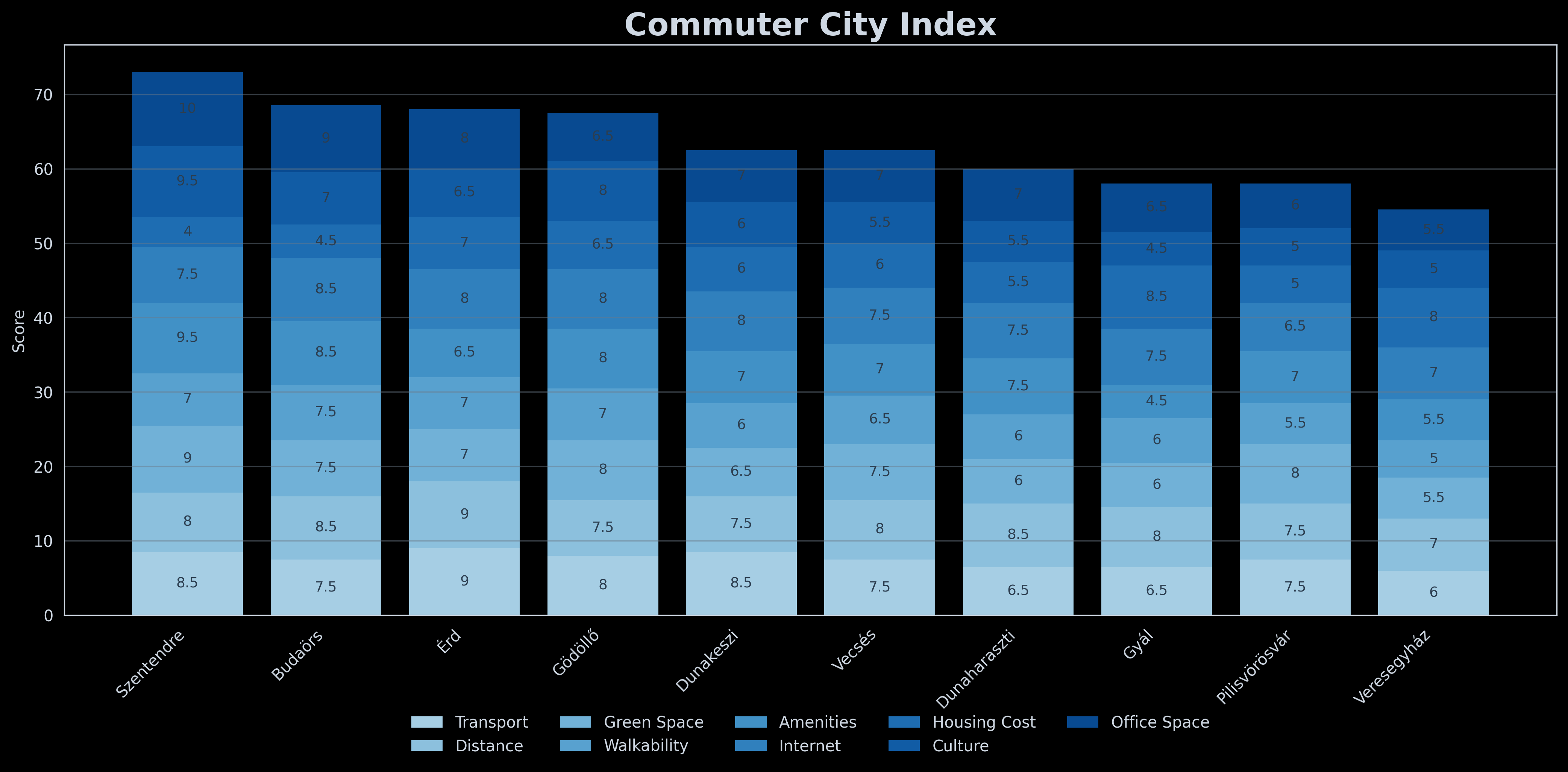
Budapest region’s 2026 top 5 commuter towns*
- Szentendre
- Budaörs
- Érd
- Gödöllő
- Dunakeszi
Szentendre takes the top spot (73.0)
Szentendre scored highly due to its exceptional cultural life, rich green environment, strong HÉV-based connectivity to Budapest and the presence of an in-town Regus flexible workspace centre. The town uniquely combines lifestyle quality with hybrid-work readiness, making it the most balanced commuter location in the index and a clear leader among Budapest-area commuter towns.
Budaörs is a strong runner-up (68.5)
Thanks to its outstanding proximity to Budapest, strong amenities, reliable broadband infrastructure and fast access to the Regus centre in nearby Biatorbágy, Budaörs has cemented its place as runner-up. Its premium connectivity and hybrid-work accessibility make the town especially attractive for professionals seeking suburban quality of life without sacrificing business access to the capital.
Recognising the surge in interest for top-quality flexible workspaces closer to where people want to live, IWG currently operates flexible workspace locations in Szentendre and nearby Biatorbágy, supporting hybrid working across the wider Budapest commuter belt. International Workplace Group’s rapid expansion has led to around 1,000 locations added in the last year and achieving highest ever revenue - with more new locations signed and opened in 2025 than in the first 15 years of its operations. IWG’s network now comprises more than one million rooms in 121 countries.
This report comes as new research from IWG highlights just how valuable more flexible ways of working have become to workers’ decisions about where to live and work. Only 4% of people globally are willing to commute for more than an hour to their workplace daily, while 88% say the ability to work close to home in a professional space is important when choosing where to live.
Younger workers are leading this shift, with 75% of Millennials and 72% of Gen Z willing to live further from city centres if flexible workspaces or good transport links are available. This trend reflects the growing prioritisation of a work-life balance and affordability, with proximity to flexible workspaces often outweighing the traditional appeal of central locations. As a result, both developers and workspace operators are increasingly focusing on suburban hubs and well-connected commuter towns to attract this mobile and digitally enabled workforce.
Hybrid working is also having a measurable impact on wellbeing. Globally, more than half (51%) of workers say their health and wellbeing has improved since working in a hybrid way, and 43% being able to spend more time with their friends and family. Reflecting these priorities, nine in 10 (90%) people around the world say they would consider moving to a different town or city in order to improve their quality of life.
Mark Dixon, Founder and CEO of IWG, said:
“Technology and the embrace of AI is rapidly reshaping how we work and where we live, turning commuter towns, or so-called dormitory towns, into vibrant hubs for working and living.
The idea that every morning, office workers wake early, jump into polluting cars or overcrowded trains, and travel many miles to their place of work will very soon be a crazy thing people only did in the past,” says Dixon. “Hybrid working improves our lives. And it makes us significantly better off, too.”
Commuter Town Index Graph: