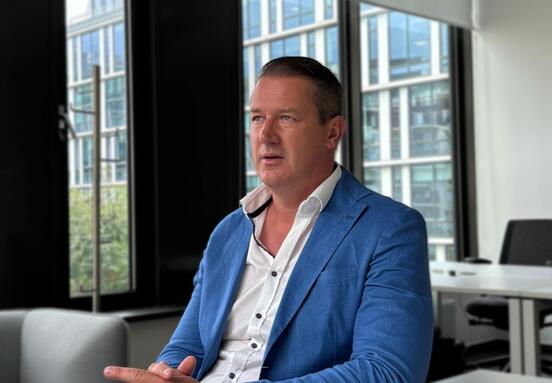
At this year’s Hungarian Real Estate Development Award, organized by the Hungarian Chapter of FIABCI, the Liget Center project stood out among the entries: WING’s development received first prize in its category, a shared third place overall, and the special award of Irodakereso.info. Mr. Gábor Angel, Deputy CEO responsible for office developments at WING Zrt., spoke with us about the project that seamlessly blends heritage preservation with cutting-edge workplace design.
- Congratulations on the multiple awards! Why did WING nominate the Liget Center for this prestigious award? What vision or strategic objective lay behind selecting this project?
- The Liget Center project reflects WING’s commitment to responsible stewardship of the built environment: we believe that architectural heritage is treated responsibly when we succeed in assigning new, relevant functions to it in the present day. In this case, a highly distinctive modernist building complex with heritage value was renewed right next to City Park (Városliget), while creating modern, sustainable office spaces – including areas tailored to the specific needs of RTL’s production operations – that seamlessly integrate into the urban fabric. The project embodies a unique combination of respect for architectural heritage and a forward-looking vision: how to revitalise an iconic building in Budapest so that it becomes an inspiring, technologically advanced workplace aligned with today’s tenant expectations. I am truly glad to have been part of it. We nominated it because it was an exceptionally complex project from a professional perspective, and we felt that this type of responsible, value-driven mindset deserves to be showcased to a wider professional audience. It was particularly important to me personally because it is rare to have the opportunity to transform the entire operation of a historically significant building complex with such a cohesive and well-considered approach.
- The Liget Center is unique in that it is both a heritage reconstruction and a modern office development. What professional or technical challenges did you face in preserving the historical value of the buildings while creating a contemporary, competitive office complex?
- The reconstruction of heritage-protected buildings is always complex, and this was especially true for the Liget Center. On the one hand, we had to preserve the original character of the Classic and Auditorium buildings, requiring precise heritage-focused restoration; while on the other hand, we needed to integrate modern functions and state-of-the-art mechanical and energy systems tailored to the specific requirements of RTL Hungary’s production activities. The result is one of the greenest heritage buildings in Hungary. Since then, the prestigious international law firm Wolf Theiss has also chosen the Liget Center as its new headquarters, which it will occupy in early 2026. The development also includes Vitrum, a newly built six-storey boutique office building, which enriches the complex’s character and functional diversity. Harmonising modern architecture with the historical structures, achieving high energy efficiency, and meeting contemporary tenant expectations presented simultaneous aesthetic, engineering, and development challenges. I believe the key to success was approaching these not as compromises but as mutually reinforcing ambitions.
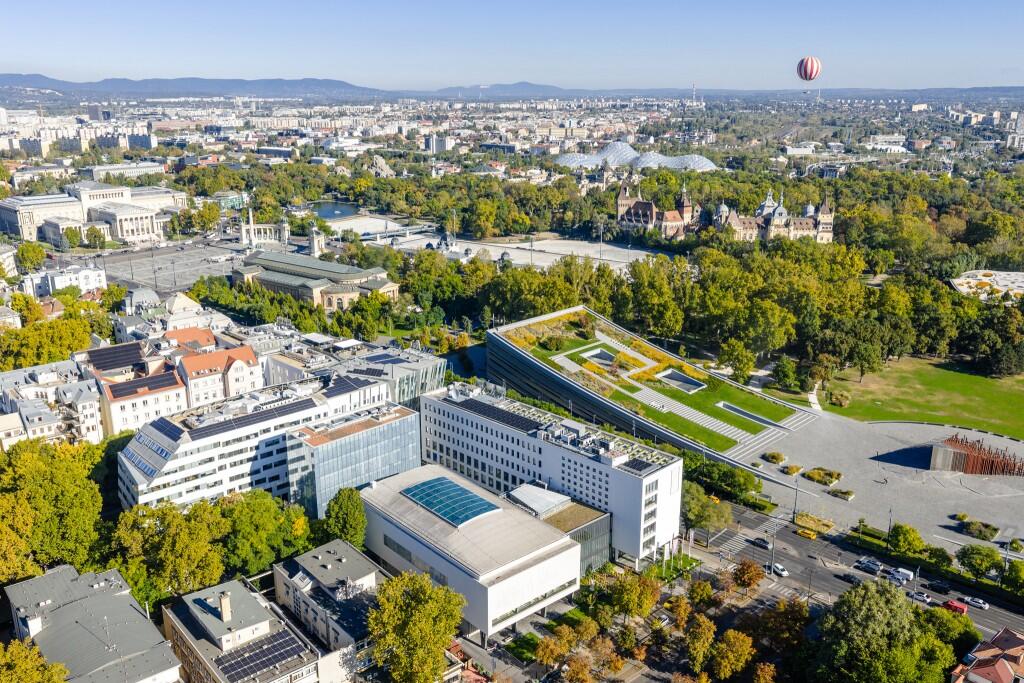
- The building has earned several recognitions, including our special award. In your opinion, what made the Liget Center stand out to both the jury and the professional team at irodakereso.info? What qualities or added values were particularly convincing?
- I would highlight that the foundation of the Liget Center’s recognitions lies in a degree of complexity rarely found in a single development. It simultaneously delivered architectural heritage preservation, modernisation based on environmentally conscious solutions, and the creation of a distinctive office environment tailored to the needs of today’s tenants. Feedback clearly shows that the jury and the irodakereso.info team were particularly convinced by the way we introduced new functions to the building complex while keeping its historical values naturally at the centre. We restored the valuable relief by István Tar, an important artwork enriching the facade of the Auditorium building, and reinstated Dezső Lányi’s fully restored sculpture, titled Construction Workers, at the entrance facing the avenue. Another important aspect was the boutique character of the Vitrum office building – its distinctive, recognisable identity, which offers a prestigious yet people-centred environment supported by flexible, community-friendly solutions. I believe the Liget Center is therefore simultaneously aesthetically outstanding, functionally competitive, and forward-looking in terms of sustainability. It has not only contributed to the renewal of the district but also set a new quality benchmark in the Hungarian office market.
- Sustainability played a prominent role in communications. Which sustainability or energy-efficiency solutions do you consider most important in the Liget Center? Is there any technology or innovation you are particularly proud of?
- At the Liget Center, environmental consciousness was not an add-on but a mindset permeating the entire development, from construction to operation. One of the most important achievements is that the Vitrum office building obtained a BREEAM “Very Good” certification, while in the reconstruction of Classic and Auditorium we applied solutions that enabled the more than 70-year-old heritage buildings to become nearly zero-energy buildings. Accomplishing this in such buildings was a significant engineering challenge. It is also important that the entire complex operates with 100% green electricity, while heat-pump systems, modern building-management technologies and green roofs further enhance environmentally friendly operation. At the same time, the renovation is also an approach based on circularity and sustainability, which has less impact on the environment.
- Distinctive offices with strong identity play an important role in WING’s portfolio. How does the Liget Center fit into WING’s long-term development strategy?
- It has always been essential for us to create buildings with genuine character and identity, which represent lasting value while also responding flexibly to the evolving demands of modern work – and we see that our tenants also greatly appreciate and even seek out spaces where the identity of a unique building becomes part of their everyday working environment. The Liget Center perfectly embodies this philosophy. For us, it is crucial that our developments aim for the highest standards in architecture, sustainability and customer-centric design, and the Liget Center proves that this is achievable even in historical buildings. Through the revitalisation, we succeeded in giving new life to a long abandoned and deteriorating heritage property, aligning with our commitment to meaningfully contribute to the renewal of Budapest’s built environment.
- What does this broad recognition mean to you, and how do you plan to leverage the prestige of these awards in future developments, communications or tenant relations?
- Professional recognition, including awards, provides valuable confirmation of our work, especially when it involves exceptional complexity and the coordinated collaboration of many disciplines. This success would not have been possible without the dedication of my colleagues. The project was designed by TIBA Architect Studio, with general construction carried out by WORKUP, FITOUT's specialized division, and LAB5 architects responsible for the interior design of the RTL areas. A prestigious professional award is a credible endorsement for tenants, partners, and the international market alike. In practice, this means that we will use the Liget Center as a reference for future developments, especially when it comes to historic building revitalization, boutique offices, or high sustainability standards.
Officerentinfo.hu