



The second phase of H2Offices will be one of Budapest’s first office developments designed for carbon-neutral operation. To what extent is there a genuine tenant demand today for sustainable, ESG-compliant offices, and to what extent has this already become an “expectation” on the part of large corporations?
In my view, sustainability is no longer a differentiator for large occupiers — it is increasingly becoming a baseline expectation. For many international companies, especially those with established ESG commitments and reporting obligations, it is already part of the decision-making framework rather than an added benefit. What has changed most is the quality of the conversation. Tenants are looking beyond declarations and asking how buildings actually perform: how energy-efficient they are, how they address operational carbon, what kind of indoor environment they provide and how robust the underlying data is. That is a positive development, because it pushes the market toward greater transparency and higher standards with concrete facts to support it. At the same time, even a strong sustainability profile is not enough on its own. Occupiers are looking for the full package: ESG performance, workplace quality, strong connectivity and long-term business relevance. At H2Offices Phase 2, we are seeing that clearly. The project’s leasing momentum shows that companies are prepared to commit early when a development brings these elements together in a credible way. For us at Skanska, that confirms that sustainability creates the most value when it is fully integrated into the overall quality and usability of the building
The project is being developed along the Váci corridor, which has seen a significant wave of development in recent years. How do you view the competitiveness of this location today, and what factors determine which submarket a company chooses in Budapest?
The Váci Corridor remains one of Budapest’s strongest office locations because it continues to deliver on the fundamentals occupiers’ value most. It combines strong public transport connections, proximity to the city centre, mature infrastructure and a broad range of services. What has changed is that companies are choosing more holistically than before. Today, they look not only at the building itself, but also at commute times, accessibility, nearby amenities and the overall daily experience the location offers employees. In that respect, the most competitive submarkets are those that work both as business locations and as places people genuinely want to come to. That is why the Váci Corridor continues to perform strongly.
Hybrid work is here to stay, while new office developments continue to emerge. How has office design changed as a result: what features and communal spaces are tenants looking for most today?
Hybrid work has fundamentally changed the role of the office. It is no longer just a place to work from; it has to support the activities that are hardest to recreate remotely — collaboration, learning, culture and informal interaction. As a result, office design has become much more focused on flexibility and experience. Tenants are looking for communal spaces that can support different modes of work throughout the day, from informal lounges and multifunctional meeting areas to welcoming lobby spaces and outdoor areas. At the same time, the definition of quality has broadened. Natural light, indoor air quality, acoustics, comfort and access to greenery now play a much bigger role in how occupiers evaluate office space. The most successful offices are the ones that feel purposeful, comfortable and worth the commute.
A key element of the H2Offices development is the green environment and a focus on wellbeing. To what extent are extra services such as public parks, recreational spaces, or smart building solutions considered a competitive advantage in today’s office market?
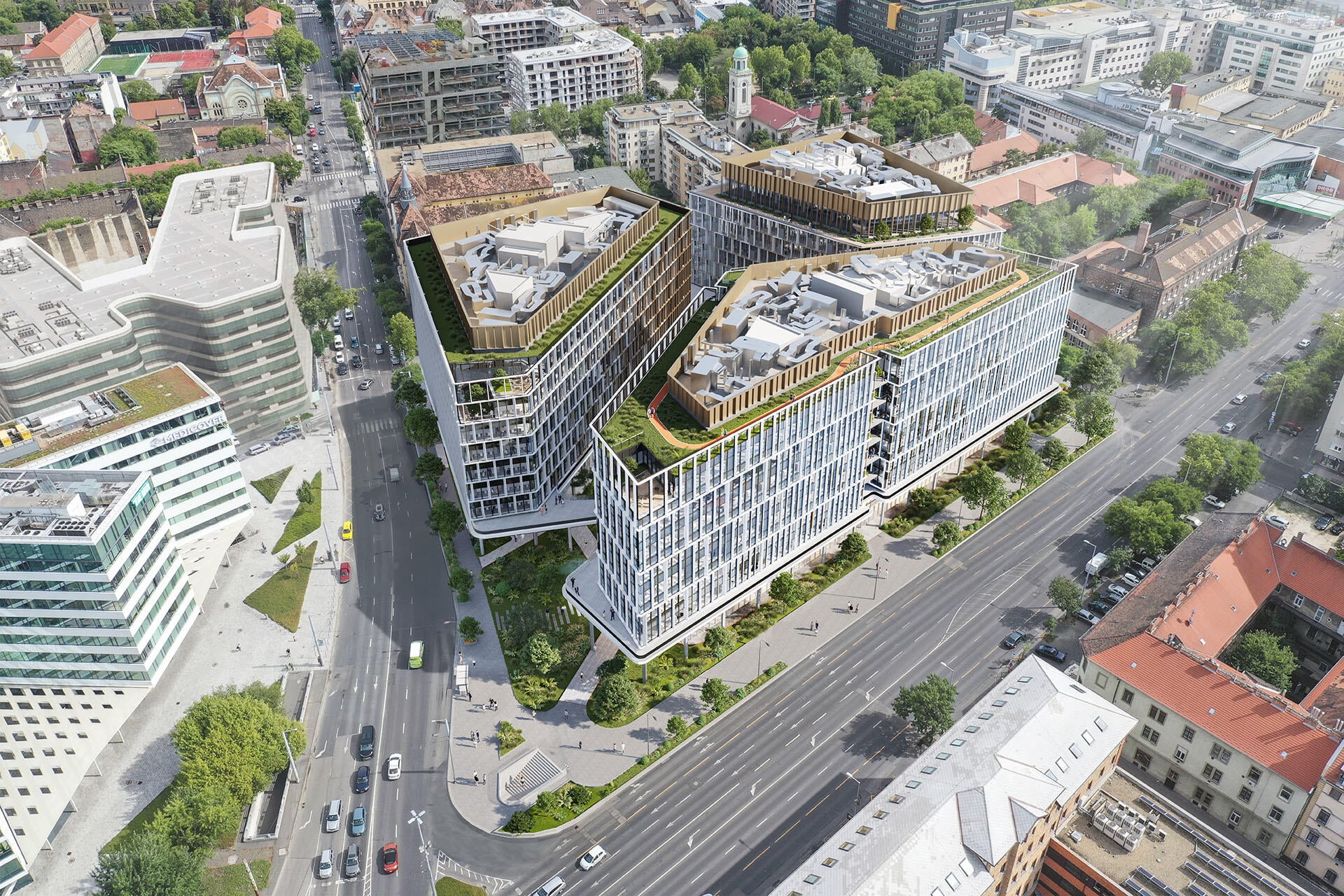
I would say these features are no longer simply added value — they are increasingly part of what makes an office development competitive. As the technical standard of new buildings continues to rise, occupiers are paying much more attention to the broader quality of the workplace environment and the everyday experience it offers. Green areas, recreational spaces and smart building solutions all shape how a building performs beyond its core function. They can support wellbeing, improve usability, strengthen employee satisfaction and contribute to more efficient operations. In that sense, they are not cosmetic extras; they are part of how companies assess whether a building will remain relevant and attractive over time. At H2Offices, these elements were integrated into the project from the very beginning. From the public garden and rooftop running track to the smart building solutions and shared outdoor spaces, the ambition was to create more than office space. From a Skanska perspective, a successful development should contribute positively both to the people using the building and to the wider urban environment around it.
There has been much talk recently about how demand for modern, premium offices remains stable, while older buildings are facing a tougher situation. Do you think the Budapest office market has split into two?
There is clearly a growing distinction between modern, high-quality office developments and parts of the older office stock that no longer fully match current occupier expectations. Companies are placing much greater emphasis on sustainability performance, operational efficiency, flexibility and workplace quality when making leasing decisions. That said, I would not describe the market as fully split into two. Many existing buildings still have strong potential through refurbishment and repositioning. We expect renovation activity to play an increasingly important role in the coming years as landlords respond to evolving ESG standards and changing workplace needs. For modern, well-located developments, demand remains relatively resilient, particularly where larger, high-quality spaces are available and the long-term operational performance of the building is clear.
From a developer’s perspective, what is the biggest challenge today: construction costs, financing, tenants’ wait-and-see attitude, or rather rapidly changing workplace needs?
Today, developers need to navigate several major factors at the same time. Construction conditions remain demanding, while occupiers are becoming more deliberate and strategic in their workplace decisions. Financing also remains an important consideration across the broader market. At the same time, Skanska’s self-financed development model means we are not dependent on external project financing, which gives us the ability to maintain a long-term perspective in how we invest and develop. That is particularly important in a market where timing, quality and adaptability all play a growing role in project success. This shift is also creating opportunities for developments that can respond to changing expectations around sustainability, flexibility and workplace quality. Companies are looking far beyond square meters today. Office decisions are increasingly shaped by talent attraction, company culture, operational efficiency and long-term resilience. From our perspective, this makes long-term planning and adaptability more important than ever. We believe the projects that will perform best are those that combine strong fundamentals with the flexibility to evolve alongside occupier needs over time.
Looking ahead 5-10 years: what do you think a successful office building in Budapest will look like? What trends – such as carbon neutrality, flexible spaces, technological integration, or community features – are most likely to shape the market?
Over the next 5-10 years, I believe successful office buildings in Budapest will need to be much more adaptable than in the past. Workplace habits, technology and sustainability expectations are all evolving quickly, so buildings will need to support change over time rather than one fixed way of working. Carbon-neutral operation, smart building systems and flexible layouts are likely to become increasingly standard expectations, with greater emphasis also placed on hospitality-inspired experiences and a sense of comfort more commonly associated with home. At the same time, the focus will go beyond how buildings perform in operation to how they are developed in the first place. Reducing carbon emissions through design choices, material selection and procurement is becoming an essential part of delivering long-term value. At H2Offices Phase 2, for example, we achieved a CO2 saving of 2,200 tonnes during construction compared with a conventional building of the same size. To put that into perspective, that is roughly equivalent to taking 500 cars off the road for a year. For me, this underlines an important point: carbon reduction starts long before a building becomes operational. More broadly, I believe the strongest projects will be those that combine resilience, flexibility and responsible development with a clear understanding of how cities and workplace cultures are evolving. At Skanska, that means creating buildings that are prepared not only for current market expectations, but for how occupier needs, environmental standards and urban life will continue to change in the years ahead.