
Please briefly summarize what kind of year you’ve had!
Let me rephrase the question. If you asked what I am most proud of, I would say this: in a burdened market like Hungary, Convergence has been present as an independent company since 2004, and it has not only survived the past periods but has also successfully overcome the obstacles. When we talk about “rebuttoning” or repositioning office buildings, our name is practically unavoidable in Budapest.
Does this, for example, apply to ACADEMIA?
Yes, but I could just as well mention CityZen, Kálvin Square, or ZenGarden.
The office market is not living its brightest days, yet you remain consistently optimistic. Where do you now see the light in the darkness of night?
Yes, I continue to believe in the office world, and precisely along the same cornerstones as before: there are good locations, meaning those that can be interpreted as long-term and crisis-resistant. I include the Downtown, Inner Buda, and the section of Váci Road up to Árpád Bridge, and then there are areas outside these. Five years ago, everything worked. With slight exaggeration, almost anything could be leased out, but the moment a slight downturn or economic slowdown occurs, I observe that the listed areas are those that represent value in the long term. If we look at a well-managed office building with good services in these locations, we can see that in such cases we are talking about a landlord’s market.
Let me challenge you a bit: the vacancy rate is slowly but surely increasing.
This is mainly visible where the homework was not done, where ESG was not addressed in time, where the necessary facelift did not take place, or where the location is poor. The latter is the most important. If the location is good, the technical content, aesthetics, and services can be developed. But if the building is in a bad location, then it is indeed difficult to fill it with tenants.
Many in the market are talking about two distinct trends emerging: one is that artificial intelligence simplifies quite a lot of tasks, reducing the importance of human resources. In Budapest, 40,000 people work in call centers, but the number of these jobs will decrease in the not-so-distant future. Not entirely independently from this, it can also be seen that the previous classic recipe – leasing an office for 5 years under fixed conditions, which undeniably provided a predictable and plannable framework – is now less acceptable for tenants. Many prefer to extend or look for flexible solutions. What do you perceive from this, and how can you plan?
My view is that for most job roles, a company functions well - meaning efficiently – if colleagues work together.
You mean physically?
Yes, physically. I am convinced that in most job roles a company operates efficiently if colleagues work together – physically as well. This requires an office. It is possible that, for example, in the case of an IT company, instead of the previous 500-person office, today 250 workstations are sufficient, but the demand for office space remains. Its function is transforming: the office becomes a space for collaboration, not merely a collection of desks and computers. Regarding AI, we have already had a similar experience during Covid, when many envisioned the end of traditional office usage and thus the office market. Today we know exactly that this did not happen. AI will not be such a breakthrough force shaping the office market as some think.
At the same time, you acknowledge that the office market is changing.
Of course! I have been working in this profession since 1998, and yes: the office market is constantly changing. But never as drastically and not as dramatically as some would like to portray.
Do your colleagues have any reason to worry?
Not at all. Outstanding professionals work with us in a family-like environment, in a stable team for years. On the investor side, we are backed by partners such as Europa, the pan-European real estate investment manager. Convergence is a small company – we are likely not planning to change that – and this is particularly advantageous: we are fast, efficient, and flexible.
Can you give a specific case study?
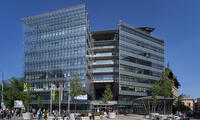
ZenGarden is a good example of the type of activity where I would say we have serious experience and have achieved nice successes. We purchased the building five years ago, when it was still operating under the name Central Business Center. It is located in one of the best locations of Inner Buda, with excellent transport, but half a decade ago it was a neglected building. Although we took it over with nearly 90% occupancy, the average rental fee was extremely low. We saw the development potential in it. In recent years, we have not only carried out technical renewal but also rethought the tenant mix, which represents significant added value at the upcoming sale.
Does this mean you are ready for sale?
Yes, if the right offer arrives.
What is the investor market like now?
Extremely dry. Traditional Western capital is currently difficult to address. The bottleneck is not bank financing but finding an investor partner.
Would you have ideas about what would be worth buying, but due to the caution and restraint of the financing background you are currently on standby? In other words, there would be targets, but you are waiting?
That is exactly the challenge.
What does your 2026 business plan include?
I expect a rebound in the second half of the year. I see that the current cautious market sentiment may be followed by gradual recovery, and we are preparing for this consciously. Our 2026 plan is not only about stable operations but also about preparing new projects and taking on new challenges. We continuously examine opportunities where we can enter with a value-adding approach - whether it is repositioning or assets with development potential. The current period is partly about preparation: we analyse targets, build relationships, and are ready to react quickly and efficiently when investor activity picks up. The year therefore represents both disciplined operation and openness toward new projects, new partnerships, and new professional challenges.
Your branding, website, and Convergence social media platforms have recently been renewed. What is the core message?
Our core values remain unchanged, while we breathe together with the market. We understand, respect, and love this world, and we envision our future here for the coming decades. This rebranding is not a change in direction but a conscious step in development. We have been present in the market for more than twenty years, and the time has come for our external appearance to reflect the dynamism and mindset by which we operate. The new identity is more youthful, more dynamic, and trendier – it visually expresses the energy and confidence with which we approach challenges. The market environment is more uncertain and cyclical than before, and in this context “resilience,” meaning adaptability and resistance, is a real competitive advantage. This is what we believe in: flexibility, rapid response, and conscious repositioning. The timing of the renewal was therefore also timely – it was important for us, at the threshold of a cycle turning point, to make it clear in our communication as well: we stand on stable foundations, yet we are continuously capable of renewal. The new appearance thus communicates both stability and openness. It shows that we are planning for the long term, we trust in the future of the market, and in a changing environment we do not want to be defensive but to be present in an initiating, flexible way. Today this is not only a communication decision but also a strategic statement.